
Grace-Period Registration vs BHU Recognition: What Is the Difference?
By Holling One-Stop BHU Certification | Last updated: 23 November 2026
Short answer
- Grace-period registration is a transitional arrangement. It is free and the registration period closes on 28 February 2027. A registered SDU can continue to be let during the grace period (until 28 February 2030) while the owner converts the unit and applies for recognition. Registration does not mean the unit meets BHU standards.
- BHU recognition is the long-term requirement. The unit must meet the eight minimum standards of living conditions and be certified by a specified professional. Recognition is valid for 5 years and can be renewed. The standard Government fee is $3,000 per SDU, but applications submitted on or before 28 February 2027 are free, and registered flats enjoy a longer free period (see the fee table below).
- From 1 March 2030, only SDUs with valid BHU recognition may be lawfully let.
Registration vs recognition at a glance
| Item | Grace-period registration | BHU recognition |
|---|---|---|
| Purpose | Allows letting to continue during the grace period without enforcement for unlawful letting | Confirms the unit meets the minimum standards and may be lawfully let |
| Application period | 1 March 2026 to 28 February 2027 | Any time; no deadline |
| Eligibility | At least one subsisting domestic SDU tenancy between 4 July and 3 October 2025 | Meets the eight minimum standards; relevant statutory orders complied with |
| Conversion works first? | No | Yes, if the unit does not yet meet the standards |
| Who applies | Owner or operator | Owner, or a person with the owner’s written consent |
| Professional certification | Not required | Required; the applicant engages a specified professional |
| Form | REG-01 | BHU-01 (renewal BHU-01A) |
| Government fee | Free | $3,000 per SDU, reduced to $1,500 or free during the early-bird period (see below); renewal $2,400 |
| Validity | Until the grace period ends (28 February 2030) | 5 years, renewable |
| Public information | Flat address will be published on the Government website | Address, validity period and a location plan of the unit will be published on the Government website |
Summarised from the Government’s grace-period registration and BHU recognition pages.
Early-bird fees for BHU recognition: what do you gain by registering?
To encourage early registration and recognition, the application fee depends on when the recognition application is submitted and whether (and when) the flat was registered (per SDU):
| Recognition application submitted | Flat registered 1 Mar – 31 Aug 2026 | Flat registered 1 Sep 2026 – 28 Feb 2027 | No grace-period registration |
|---|---|---|---|
| 1 Mar 2026 to 28 Feb 2027 | Free | Free | Free |
| 1 Mar 2027 to 29 Feb 2028 | Free | Free | $1,500 |
| 1 Mar 2028 to 28 Feb 2029 | Free | $1,500 | $1,500 |
| From 1 Mar 2029 | $3,000 | $3,000 | $3,000 |
In short: recognition applications submitted now and up to 28 February 2027 are free for every SDU; after that, registered flats keep a longer free period. Renewal costs $2,400 per SDU. These are Government application fees only; conversion works and professional certification are separate.
Already registered — why is recognition still needed?
Registration only buys time; it is not a long-term letting permit. The Government states that:
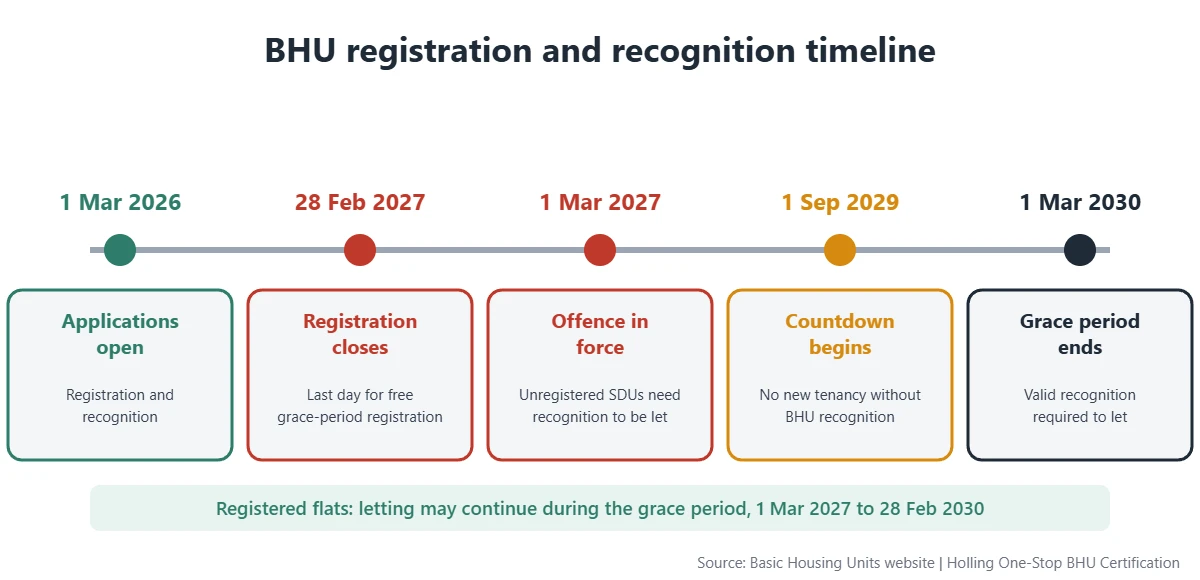
- the grace period runs from 1 March 2027 to 28 February 2030, during which no enforcement action for unlawful letting will be taken against registered flats;
- during the countdown period (1 September 2029 to 28 February 2030), no new domestic tenancy may be entered into for an SDU without valid BHU recognition;
- from 1 March 2030, enforcement action will be taken against SDUs without valid BHU recognition.
So after registering, owners still need to complete conversion and obtain recognition within the grace period. The earlier you start, the less the countdown period affects you.
Missed registration — can I apply for recognition directly?
Yes. BHU recognition has no deadline and does not require prior grace-period registration. The difference is that an SDU without registration must hold valid recognition before it can be let from 1 March 2027, with no grace period.
Suggested order
- Check whether the flat is regulated: see Which Flats Are Not Regulated by the Basic Housing Units Ordinance?
- Register if eligible: free, closes on 28 February 2027. See BHU Registration Deadline.
- Deal with statutory orders: see Building Department Orders and BHU Recognition.
- Apply for recognition: see How to Apply for BHU Recognition.
FAQ
Does grace-period registration mean the unit is compliant?
No. Registration only allows the SDU to continue to be let during the grace period. The unit must still meet the eight minimum standards and obtain BHU recognition separately.
How long is BHU recognition valid?
Five years. A renewal application must be made within three to six months before expiry, with a specified professional certifying again that the unit still meets the standards.
How much is the Government fee for BHU recognition?
The standard fee is $3,000 per SDU and renewal is $2,400. Applications submitted on or before 28 February 2027 are free; after that, depending on whether and when the flat was registered, the fee may be $1,500 or remain free, and from 1 March 2029 it is $3,000 for all. Grace-period registration is free.
Can I apply for recognition without registering first?
Yes. Recognition does not require prior registration, but an unregistered SDU must hold valid recognition before it can be let from 1 March 2027.
Sources
- Basic Housing Units website: Grace-period registration
- Basic Housing Units website: Basic Housing Unit Recognition
- Basic Housing Units website: Application Fees
This article is general information only and is not legal advice. Fees and arrangements are subject to the Government’s latest announcements.