
Converting SDUs to BHUs: Do You Need Owners’ Corporation Consent? DMC, Common Parts and Meters
By Holling One-Stop BHU Certification | Last updated: 23 November 2026
Short answer
- Applying for registration or recognition: the applicant must be the owner of the flat, or a person with the owner’s written consent. The Basic Housing Units Ordinance does not require the consent of the owners’ corporation (OC).
- Deed of mutual covenant (DMC) obligations still apply: the Government states that grace-period registration or BHU recognition does not negate legal obligations under the DMC or the government lease.
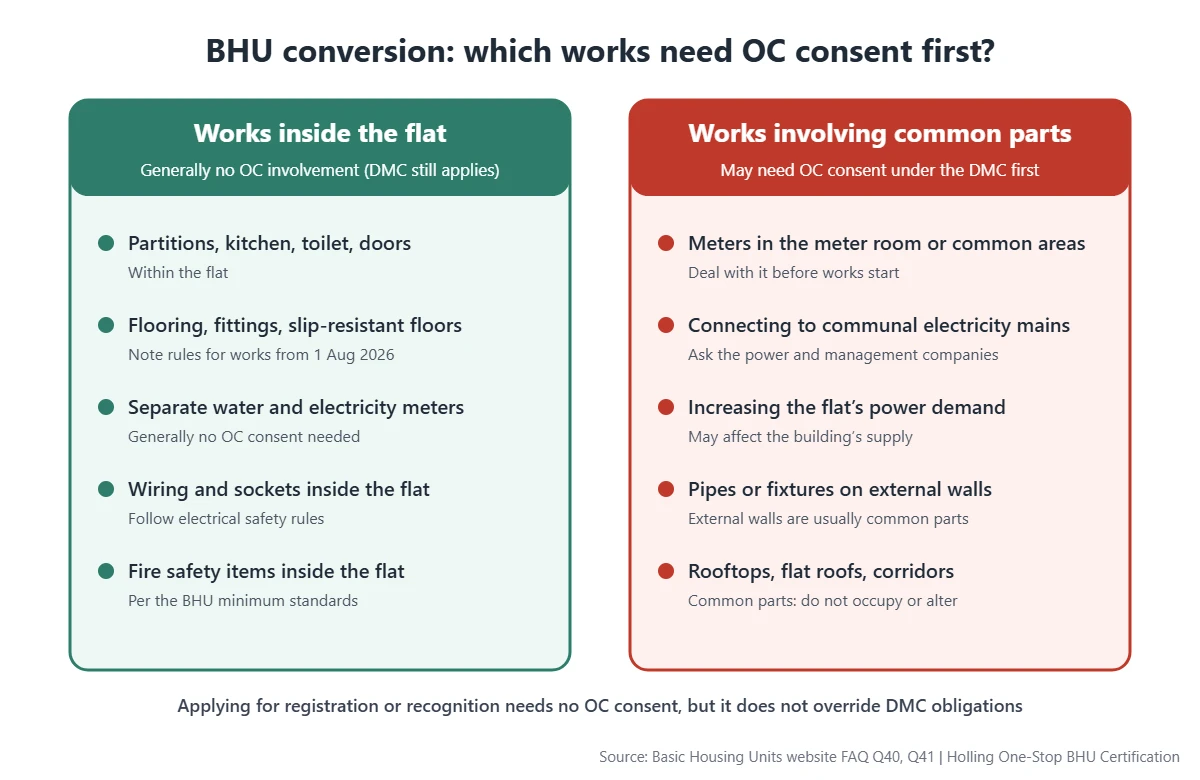
- Works inside the flat: installing separate water and electricity meters inside the flat, for example, generally does not involve the DMC and does not need OC consent.
- Works involving common parts: installing meters in the meter room, connecting to the building’s communal electricity mains, increasing power demand, or altering common parts such as external walls may require OC consent under the DMC before works start.
Common conversion works: do you need to ask the OC?
| Works | General position | Notes |
|---|---|---|
| Partitions, kitchen, toilet, doors, windows and flooring inside the flat | Generally within the flat; OC not involved | Must still comply with the Buildings Ordinance and the DMC; some DMCs impose extra restrictions on alterations |
| Separate water and electricity meters inside the flat | Generally does not involve the DMC; no OC consent needed | Government FAQ question 41 |
| Meters in the building’s meter room or other common areas | May need OC consent under the DMC | Deal with it before works start |
| Connecting to communal electricity mains or increasing power demand | May need OC consent under the DMC | Ask the power company and the management company first |
| Pipes or fixtures on external walls | May involve common parts | Unless the DMC provides otherwise, common parts under the Building Management Ordinance include external walls and roofs |
| A flat divided by deed into separately owned units, applying for one unit | Written consent of the owners of all divided units required | Government FAQ questions 19 and 31 |
| Application by an operator (sub-landlord) | Owner’s written consent required | Applies to both registration and recognition |
Summarised from the Government’s BHU FAQ. For a specific building, its DMC prevails.
Why check the DMC?
The DMC is the contract between the owners of a building. It sets out which areas are common parts and how owners may use and alter their flats. Question 40 of the Government’s BHU FAQ states that grace-period registration or BHU recognition does not negate legal obligations under the DMC or government lease; applicants remain responsible for compliance and may seek professional advice.
In other words, BHU recognition only shows that a unit meets the minimum standards of living conditions. If conversion works breach the DMC, other owners or the OC can still take action under the DMC.
Separate meters: when is OC consent needed?
Separate water and electricity meters are one of the eight minimum standards. According to question 41 of the Government’s FAQ:
- installing sub-meters inside the flat generally does not involve the DMC and does not need OC consent;
- installing meters in common parts such as the meter room, connecting to the communal electricity mains, or increasing power demand may require OC consent under the DMC before works start;
- owners can consult the Water Supplies Department, the power companies, the property management company or other professionals.
For meter technical requirements and the application process, see How to Apply for Separate Water and Electricity Meters for BHUs.
Preparation before conversion
- Confirm who is applying: the owner, or an operator with the owner’s written consent; for a flat divided by deed, the written consent of the owners of all divided units.
- Read the DMC: check what counts as common parts, any restrictions on alterations, and whether prior notice or consent is required. The DMC can be obtained from the management company or searched at the Land Registry.
- List works affecting common parts: for example the meter room, mains, external-wall pipes or extra power demand.
- Get written consent before works: submit the scope of works to the OC or management company and start only after receiving a written reply.
- Deal with statutory orders and convert to standard: see Building Department Orders and BHU Recognition and The Eight BHU Minimum Standards.
For the difference between registration and recognition and the early-bird fees, see Grace-Period Registration vs BHU Recognition.
Conversions from 1 August 2026: slip-resistant floors
Question 39 of the Government’s FAQ notes that the elderly-friendly requirements under regulation 73 of the Building (Planning) Regulations took effect on 1 August 2026. If a flat is converted into SDUs on or after that date and the works require building plan submission or fall under the Minor Works Control System, bathrooms, kitchens and toilets must have slip-resistant floors — for example when adding a new toilet or replacing all drainage pipes within a toilet. Simply replacing sanitary fittings or re-tiling does not trigger the requirement.
FAQ
Does a BHU recognition application need the OC’s signature?
No. The applicant must be the owner, or a person with the owner’s written consent; the Ordinance does not require the OC to sign. However, if conversion works involve common parts, OC consent may be needed under the DMC.
Do I need OC consent to install a separate electricity meter inside the flat?
According to the Government’s FAQ, installing sub-meters inside the flat generally does not involve the DMC and does not need OC consent; works involving the meter room, communal mains or increased power demand may need it.
Does BHU recognition mean the conversion complies with the DMC?
No. The Government states that registration or recognition does not negate obligations under the DMC or government lease.
What if the building has no OC?
Follow the DMC. In general, ask the DMC manager or the property management company first; works involving common parts should likewise have a written reply before they start.
Further reading: Do BHU Conversions Need Plan Approval? The Minor Works Control System Explained
Sources
- Basic Housing Units website: FAQ, questions 19, 25, 31, 39, 40 and 41
- Basic Housing Units website: Basic Housing Unit Recognition (who may apply)
- Legislative Council paper: Owners’ corporations and common parts (Chinese; common parts under the Building Management Ordinance include external walls and roofs)
This article is general information only and is not legal advice. Each building is subject to its own DMC; seek legal advice where necessary.